
Market Outlook
Fixed income investors were glad to put Q3 behind them as a significant repricing of interest rates drove most major market indices into negative territory. Stronger economic data during the quarter worked against returns, as it was paired with sticky inflation and concerns around growing deficits and heavy supply. The result was a more hawkish shift in monetary policy: the Fed hiked in September and signaled that more may come. As a result, Treasury yields moved higher across the curve (60-90bps), as investors demanded compensation not only for inflation uncertainty but also for mounting capital demands throughout the economy. Massive financing needs tied to AI infrastructure, fiscal deficits, corporate investment, and elevated debt issuance have created sustained competition for capital, putting upward pressure on interest rates and term premiums.
Looking ahead, the breadth of strong data suggests the economy is positioned to deliver decent growth into year-end. But we also see cracks forming; there is evidence that consumers are spending from savings, and labor market data has become more mixed and looks more vulnerable. Inflation will remain the Fed’s primary focus. Core inflation is above target but lower than earlier in the cycle, and it’s generally in a range more consistent with modest policy adjustments than an aggressive tightening cycle. As a result, we believe any additional Fed hikes will be limited to two or three, and much of that adjustment is already reflected in current market yields.
Despite a difficult quarter for bonds, the repricing in yields has improved the opportunity set across fixed income. Interest rate volatility, negative headlines, and prospects for further Fed hikes can make clients and investors forget some of the math and facts of the current situation. We believe it’s important to point some of these out:
- Yield drives returns. Starting yield remains the strongest predictor of future bond returns, and today’s 5.5% Aggregate yield provides a significantly stronger foundation than the 1% yield available entering the 2022 hiking cycle. (The average forward 5-year return over the Aggregate’s history at these yield levels has been 6.1%.)
- This is not 2022. Inflation is far lower, yields are materially higher, and investors now earn meaningful income that helps cushion additional rate volatility. (Core PCE is 3% vs. 5.5% in 2022, and the income carry for the Aggregate is 46bps a month vs. 14bps going into 2022.)
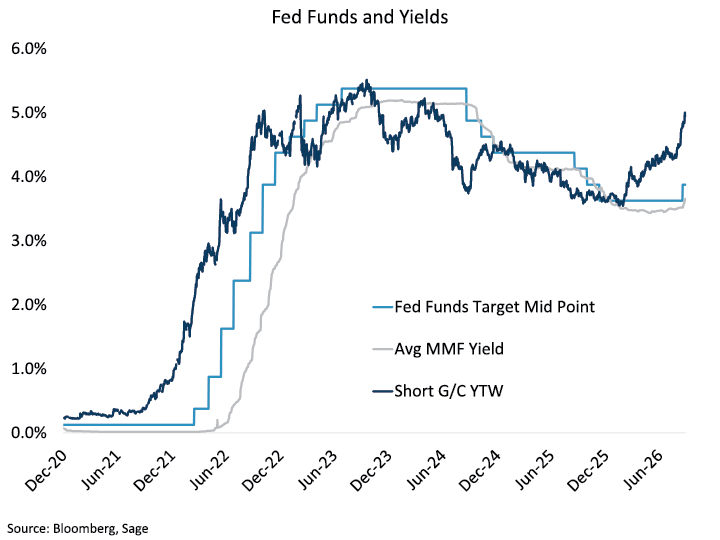
- Bond yields move before cash yields. Markets have already priced roughly three Fed hikes into yields. Bond investors earn that additional income today, while cash investors only benefit if the Fed ultimately delivers. (See Chart 1.)
- Investors are not limited to cash or long duration. Short and intermediate strategies offer attractive income, modest duration risk, and have historically demonstrated resilience when starting yields are elevated. (The Short Gov/Credit Index has never had a negative 1-year return with starting YTM above 2%; the index YTM is currently 5.25%.)
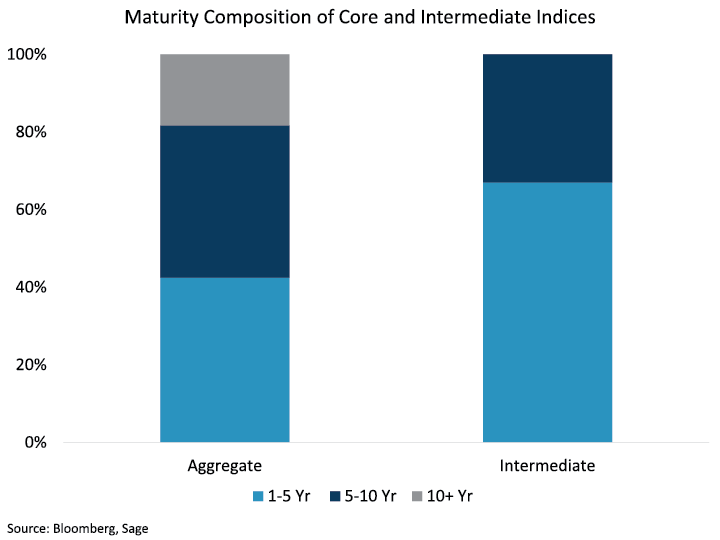
- Long-end risks are less relevant to core and intermediate bond portfolios. Structural rate pressures around deficits and supply weigh more on the long end of the curve, where core and intermediate have very limited exposure. (See Chart 2.)
Fixed Income Allocations & Recent Changes
| Sector | Positioning & Recent Changes |
|---|---|
| Duration/Curve | U.S. Treasury yields rose sharply in September, with the two-year Treasury yield reflecting multiple Federal Reserve rate hikes through the third quarter of 2027. Softer job creation pointed to moderating labor demand, but muted unemployment suggested the economy was not at risk of a labor-driven slowdown. This distinction kept attention focused on inflation, as a gradual cooling in employment may be insufficient to keep the Fed on hold if price pressures remain elevated. Meanwhile, AI-related capital investment continued to support economic activity, offsetting some weakness in hiring and reinforcing the economy’s underlying resilience. The two-year yield remained caught between softer labor-market momentum and persistent inflation risk. Looking ahead, front-end yields should remain highly sensitive to incoming inflation and employment data. |
| Investment Grade Credit | Investment-grade spreads have widened modestly from their year-to-date tights, but valuations remain only moderately attractive relative to historical levels. Competition for capital from sovereign issuers and the ongoing AI infrastructure buildout has contributed to higher interest rates and sustained issuance across the investment-grade market. Against the backdrop of a healthy economy, we believe it remains important to maintain carry in portfolios while positioning defensively. Although credit spreads remain relatively tight, all-in yields continue to provide an attractive source of income and have supported strong demand for investment-grade bonds despite robust supply. In this environment, we believe excess returns are more likely to come from issuer selection and relative value opportunities than broad spread compression. We continue to favor hard-asset sectors that are less susceptible to technological disruption, along with highly regulated industries such as banks and utilities, where valuations continue to offer relative value and meaningful downside protection. |
| Securitized | Agency mortgages underperformed significantly in September following the rise in interest rate volatility. The 10-year Treasury yield increased over 50 basis points during the month, ending at 5.28%, while the MOVE Index increased from 75 to 110. The lack of conviction on where interest rates will find equilibrium has made the mortgage sector much less appealing to many investors. While most active managers have been overweight the sector, they will remain reluctant to add until there is greater clarity on interest rates. The near-term outlook remains choppy, but we believe that the carry remains significant and that mortgage spreads will tighten when volatility subsides. Within the coupon stack, we continue to favor higher coupons, which are yielding approximately 6.25%, among the highest yields since 2002. |
| High Yield | September’s rates sell-off weighed on high yield. Total returns posted their weakest month since September 2022 as rising rates and rate volatility made investors more measured. However, total returns YTD are still slightly positive vs other longer-duration asset classes. Issuance stayed exceptionally strong and included two of the largest high yield deals on record. That brought year-to-date supply to $272bn, the highest through the third quarter since 2021. Energy rebounded to lead returns, while wirelines, cable, and building materials lagged. All-in yields are now at some of their most attractive levels in years, and the economy is still showing good strength, so we are turning cautiously optimistic on high yield given the carry priced into the market. We are not calling for a material overweight to the sector broadly, but performing credits in the 8% area are increasingly worth a look. We expect bonds with a meaningful income cushion to help insulate the portfolio from a further rise in yields, given 6–12 month forward carry dynamics. |
| Municipal | The municipal market shifted from strong summer technical support to one of its largest corrections in nearly two decades. Early-quarter demand from reinvestment cash flows and fund inflows gave way to pressure from record issuance, lower redemption proceeds, Treasury volatility, and widespread tax-loss harvesting. These forces culminated in a sharp September selloff, with the Bloomberg Municipal Bond Index declining roughly 4.4%, its weakest monthly performance since 2008, while municipal yields rose to their highest levels in more than a decade. Importantly, the downturn was driven primarily by rising rates, heavy supply, and liquidity pressures rather than deteriorating credit fundamentals, which remained resilient with modestly positive rating trends. Record issuance approaching $500 billion, elevated bid-wanted activity, and tax-loss driven repositioning created significant dislocations but also materially improved valuations. By quarter-end, municipal bonds offered some of the most attractive nominal and taxable-equivalent yields in years, creating compelling long-term income opportunities despite the challenging environment. |
Bond Yields Deliver the Income Adjustment First
Money market yields adjust with Fed hikes, so investors must wait for actual hikes to earn additional yield. Bond yields, by contrast, adjust in anticipation of future hikes and have already priced in roughly three more Fed increases, providing additional income today. Staying in money market funds is effectively a bet that the Fed will hike more than the market already expects. If the Fed delivers only what is priced in, the carry advantage of short bonds can translate into stronger total return potential than cash.
Fiscal and Term Premium Risk Lie Mostly at the Long End of the Curve
Structural rate concerns driven by fiscal deficits, Treasury supply, and term premiums are concentrated in longer maturities. Core and intermediate bond indices maintain relatively limited exposure to that part of the curve. Roughly 80% of a core bond portfolio resides within the first 10 years of the curve, while an intermediate strategy is invested entirely within that range.