
Market Outlook
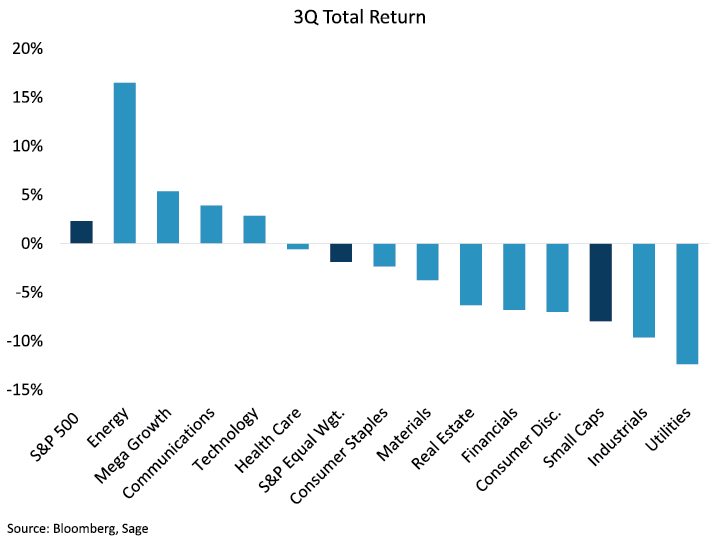
It was a challenging quarter for investors, with returns driven by a significant repricing of interest rates. Stronger economic data during the quarter worked against returns, as it was paired with sticky inflation and concerns around the rising cost of capital, growing deficits, and heavy supply. The result was a more hawkish shift in monetary policy: the Fed hiked in September and signaled that more may come. Yields rose meaningfully, climbing 60–90 basis points across the Treasury curve. From an asset class perspective, bonds felt the most direct pain, with the Aggregate Bond Index returning –3.5% for the quarter, its worst quarter since the 2022 hiking cycle. Equities posted modest gains, with the U.S. outperforming (S&P 500 +2.3%; ACWI ex U.S. +0.5%), while commodities led returns on a resurgence of oil (diversified commodities +15%). Within equities, the resilience of the broad indices, especially in the U.S., masked narrow breadth and underlying weakness. A small group of mega-cap growth and AI beneficiaries drove index returns higher (mega caps +5.5%), while most sectors struggled. Eight of 11 sectors were negative. Rate-sensitive sectors (utilities –12.4%, financials –6.8%) and cyclicals (consumer discretionary –7.0%) saw sharp drawdowns. Further, small-cap weakness (S&P 600 –8%) pointed to both rate pressure and risk aversion.
Looking ahead, the breadth of strong data suggests the economy is positioned to deliver decent growth into year-end. But we also see cracks forming; there is evidence that consumers are spending from savings, and labor market data has become more mixed and looks more vulnerable. Inflation will remain the Fed’s primary focus. Core inflation is above target but lower than earlier in the cycle, and it’s generally in a range more consistent with modest policy adjustments than an aggressive tightening cycle. As a result, we believe any additional Fed hikes will be limited to two or three, and much of that adjustment is already reflected in current market yields.
Our positioning reflects the view that investors are now being paid fairly to own duration, but not enough to aggressively reach for credit risk or push risk-asset exposure in allocations. Higher yields and a more fully priced rate environment have improved the relative attractiveness of fixed income within diversified portfolios. We reflect these views in our asset allocation by holding a lower equity position relative to fixed income than earlier in the year. We also tilt toward the U.S., given more direct inflation pressure from energy prices in Europe and Asia, and carry a more diversified sector mix to offset concentration risk at the index level. For fixed income, given the sharp repricing, we maintain full duration exposure across strategies and continue to overweight MBS and other securitized sectors, which we view as offering the best risk-reward profile within fixed income. Our non-core exposure is diversified between high yield, preferred stocks, and loans.
Equities vs. Fixed Income
We carry a modest overweight in equities vs. fixed income but have tempered it recently, adding more fixed income exposure. While our base case remains that the U.S. will avoid a recession and benefit from strong earnings and an AI-driven spending cycle, the yield reset has made fixed income more attractive overall.
| Equity | View | Reasoning |
|---|---|---|
| US Equities | Overweight | We carry a modest overweight in U.S. equities relative to international markets. The U.S. continues to have larger near-term tailwinds with a stronger earnings outlook, capex trends, and economic momentum. Stretched valuations vs. most other regions and policy uncertainty keep our overweight small. |
| Developed International | Underweight | We moved to an underweight in international equities early in the year, seeing a more attractive risk/reward profile in the U.S. Europe and other major energy-importing economies remain more exposed to elevated energy costs and supply uncertainty, creating a more persistent headwind to growth. Additionally, core European equity markets have significantly less exposure to technology, AI, and other innovation-driven industries that continue to drive earnings growth and productivity gains. |
| Emerging Markets | Neutral | We maintain a neutral allocation to EM as valuations are attractive and there is growth upside in India and parts of Asia and LATAM. This is countered by structural weakness in China and elevated macro and geopolitical risks globally. |
| Style/Sector/Factor | Large Cap | In addition to tilts toward large-cap growth sectors, we carry increased exposure to banks, industrials, and healthcare, where improving earnings breadth, attractive relative valuations, and diversified return drivers provide a compelling complement to technology and AI-related exposures. |
| Fixed Income | View | Reasoning |
|---|---|---|
| US Treasuries | Underweight | We are underweight Treasuries overall, with a tilt toward long-end curve exposure. Longer duration Treasuries provide an offset to our spread overweight and help us maintain an overall long duration posture at the portfolio level. The hawkish pivot recently has caused more movement at the front end of the curve, and we remain convinced in carrying a long duration position as inflation fears fade. |
| Investment Grade Credit | Market Weight | Market weight-type exposure still makes sense in IG credit given strong fundamentals and demand for yield, but full valuations. Rather than take a large overweight in IG spread risk, we continue to enhance our spread overweight position and overall yield with non-core sectors and increased MBS exposure. |
| Securitized | Positive | We continue to like the agency mortgage sector from both a relative value and macroeconomic standpoint. Mortgages offer attractive yields to Treasuries and IG credit without the credit risk and should benefit from lower rate volatility. We have increasingly skewed exposure toward actively managed ETFs as issuer and structural selection are an important excess return driver within securitized markets. |
| Non-Core Fixed Income | Positive | We believe a moderate allocation to non-core assets is appropriate to diversify sources of yield and return. Given tight U.S. credit spreads, we have less high yield and loan allocations in favor of increased preferred stock and high-income securitized exposure. |
Illustration of Themes – Income and Diversification
Higher Income on Fed Pricing
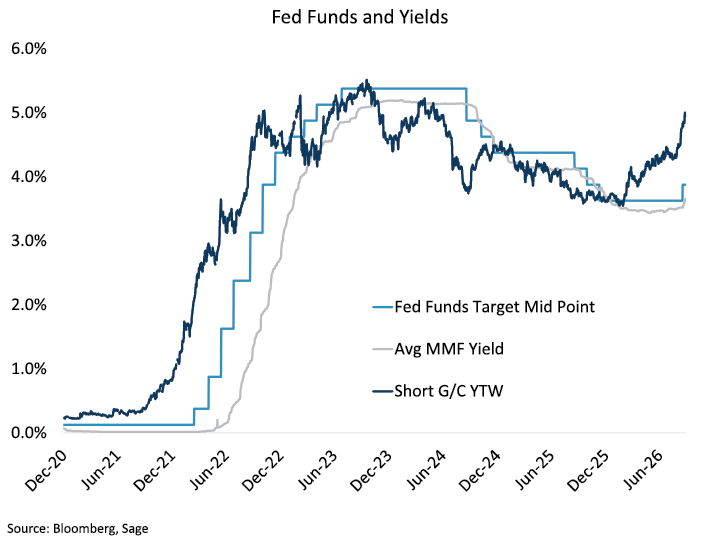
Money market yields adjust with Fed hikes, so investors will have to wait for actual hikes for additional yield. Bond yields adjust for future hikes and have now priced in three more hikes, providing additional income now. Staying in money market funds is effectively a bet that the Fed will hike more than the market already expects. If the Fed delivers only what is priced in, the carry advantage of short bonds can translate into stronger total return potential than cash.
Q3 Stealth Correction
Headline index returns during 3Q masked narrow leadership and risk aversion beneath the surface. Most sectors were negative, particularly rate-sensitive ones, as were small caps. Looking ahead, the durability of the risk-on environment will likely depend on three factors: the health of the consumer, the path and speed of interest rate moves, and corporate earnings. None currently signals an outright shift to risk-off, but all three moved incrementally in the wrong direction during the quarter, calling for a more measured risk posture. This argues for maintaining diversification, even though it did not help in 3Q.