

Agency mortgage-backed securities have been one of the more rewarding sources of high-quality spread in recent years, offering AAA-equivalent credit quality with yields that compare favorably to lower-rated corporate bonds. That return profile comes with a trade-off: MBS investors are paid to absorb interest rate volatility, and when volatility rises, the cost shows up as wider spreads. The sector’s recent weakness is best understood through that lens, as a function of how the asset class is built rather than any change in its fundamentals.
Agency MBS are backed by pools of residential mortgages and guaranteed by Fannie Mae, Freddie Mac, or Ginnie Mae, which effectively eliminates their credit risk. Their defining feature is the homeowner’s right to prepay. In practice, an MBS investor owns a high-quality bond while being short a call option on it. When rates fall, prepayments accelerate and duration shortens; when rates rise, duration extends into the selloff. This negative convexity means the sector behaves much like a short-volatility position.
That volatility has risen meaningfully under the Warsh Fed. The FOMC has deliberately reduced forward guidance, shifting the burden of price discovery from the Fed to the market. As a result, rates now reprice with each data release, and hike probabilities swing widely from one CPI or payrolls report to the next. After falling into the low 60s in 2025 while the Fed was cutting, the MOVE Index was back near 105 in early October, well above its median of roughly 76. Higher implied volatility raises the value of the option MBS holders are short, so spreads widen even though cash flows and credit are unchanged. Convexity hedging can amplify the move, as hedgers sell Treasuries to offset extending duration.
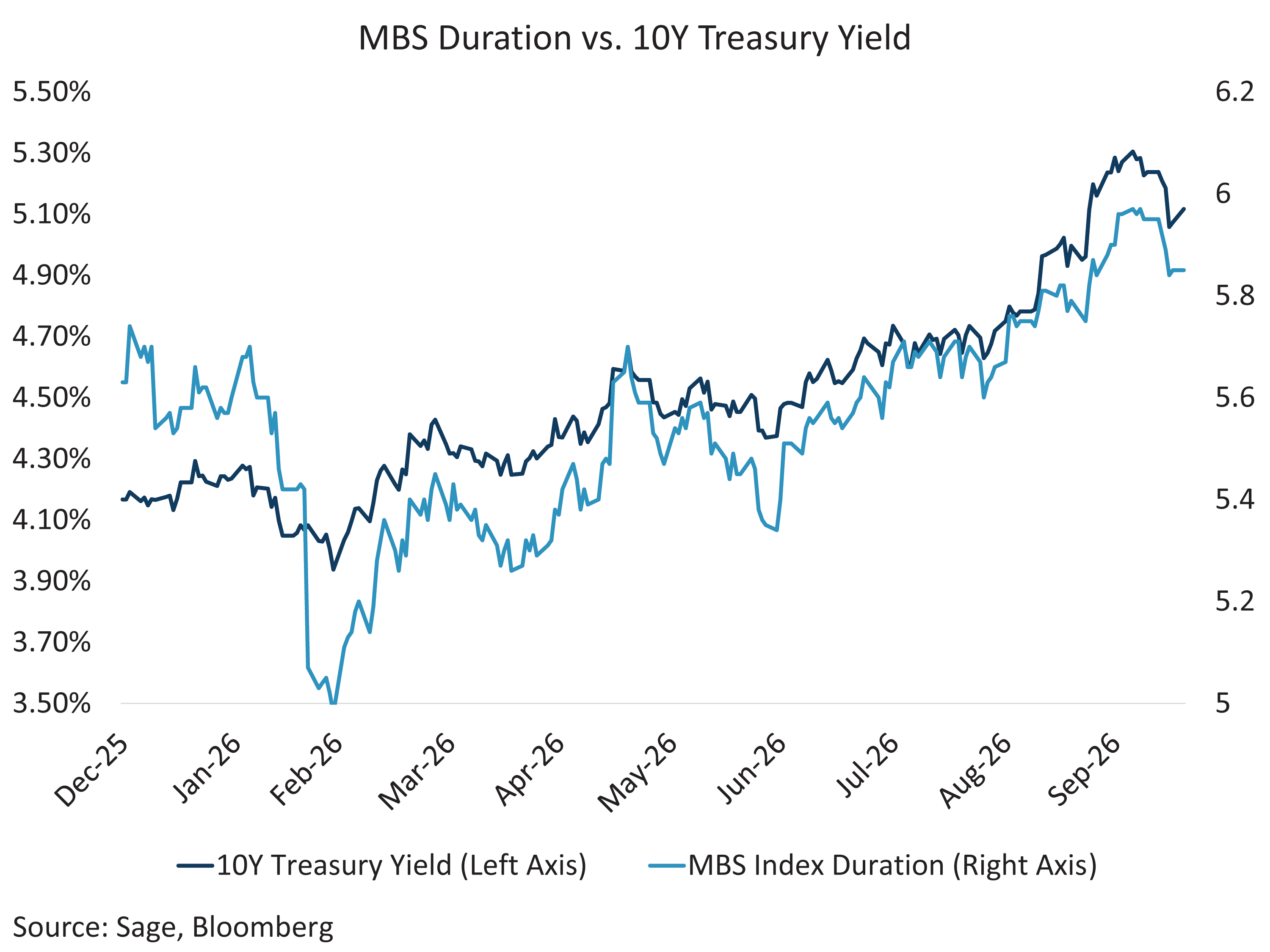
The fundamentals, by contrast, remain supportive. With current mortgage rates near their highest levels in two decades, most outstanding mortgages carry rates well below market, which keeps prepayment risk contained. That lock-in effect also suppresses housing turnover and limits net new supply. Valuations remain attractive as well: although the mortgage basis has compressed from its 2022 wides, the sector still offers yields comparable to or better than those of many lower-rated corporate bonds that carry genuine default risk.
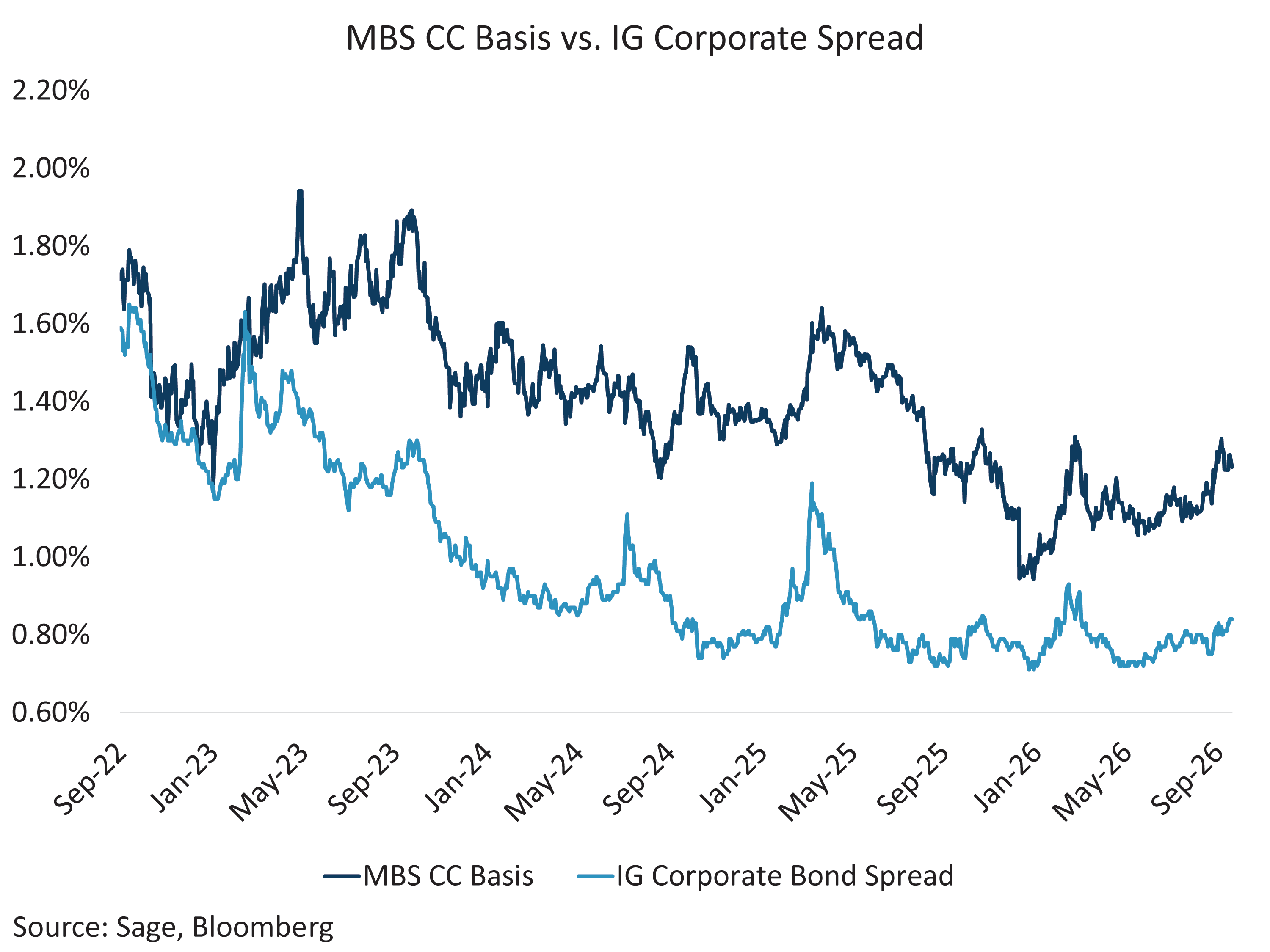
The trade-off at the heart of agency MBS hasn’t changed: investors are still paid to absorb rate volatility. Last week showed why that matters. A hotter-than-expected September CPI briefly pushed the 10-year Treasury yield to 5.33% and lifted October hike odds above 50%. Within days, concerns about AI spending and credit stress drove a flight-to-quality rally. Persistent inflation and an AI-driven growth scare are both plausible outcomes, and a Fed offering less guidance leaves the market to price both tails on its own. The recent repricing gives investors a wider margin of safety and a higher starting yield, historically the most reliable driver of fixed income returns. For long-term investors, that is attractive compensation to wait without adding credit risk.