

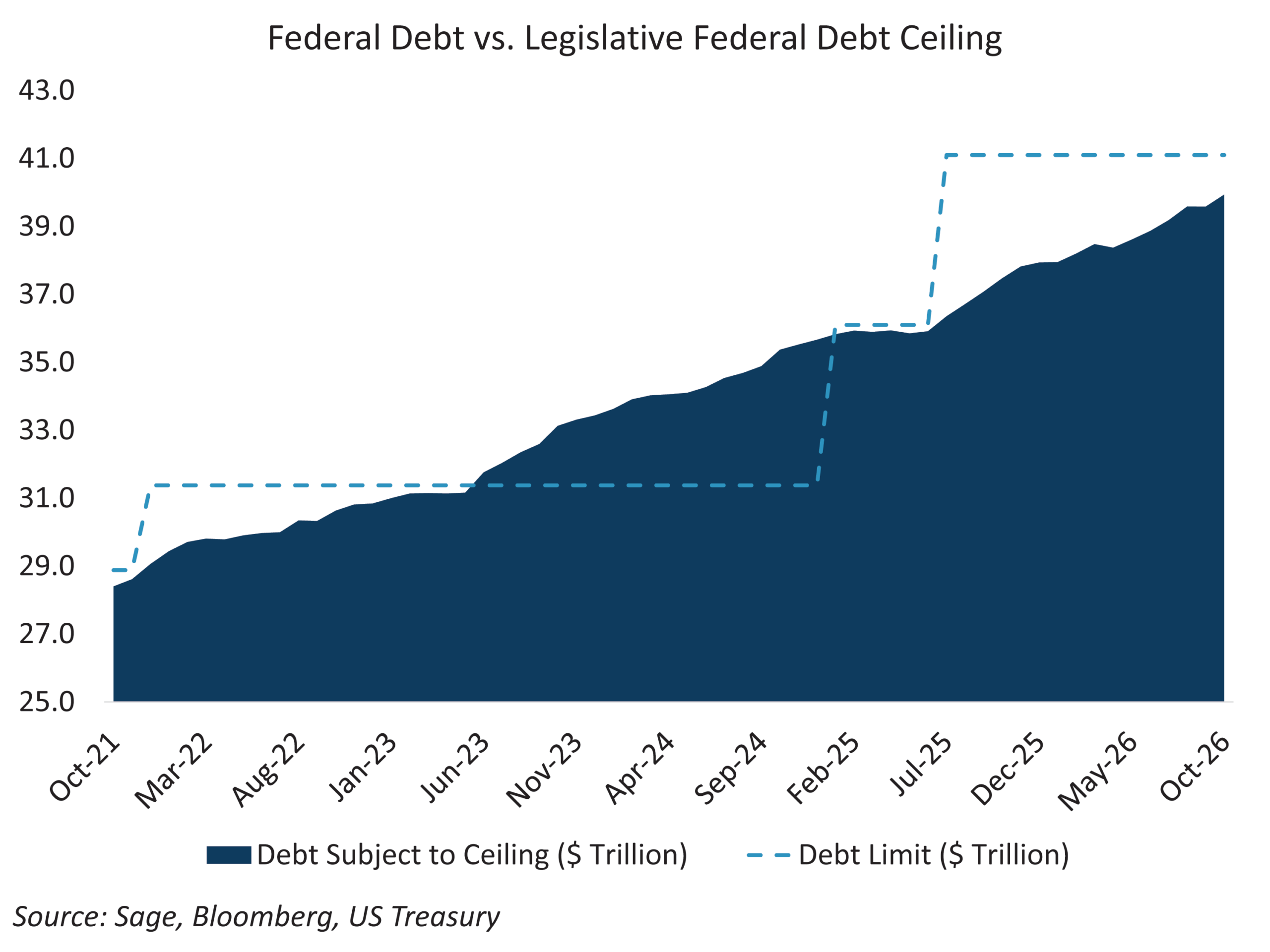
Markets have watched debt-limit episodes play out twice in the past four years, first in 2023 and again in 2025, but the next one may unfold differently. In 2023, roughly $2.25 trillion sitting in the Fed’s overnight reverse repo facility (RRP) helped absorb the Treasury’s post-ceiling wave of bill issuance. That cushion has now been almost completely drained, and the federal debt is once more closing in on its statutory ceiling. The current debt limit stands at roughly $41.1 trillion, while debt subject to the limit is already above $40 trillion. At the recent pace of federal debt accumulation, the remaining borrowing capacity could be exhausted sometime around late February or March 2027. Unless the limit is addressed beforehand, the mechanics that accompany a debt-ceiling episode will soon begin to matter for markets and should first emanate in the T-bill market.
Bill Scarcity and the X-Date
Once the debt limit binds, the Treasury can no longer freely add to its overall borrowing and begins drawing down its cash balance instead. Bills are often where the adjustment shows up first because their short maturities give the Treasury the flexibility to issue less than the amount rolling off, effectively shrinking the supply of bills outstanding. In 2025, that process reduced bill supply by roughly $600 billion, leaving money market funds and other cash investors competing for fewer securities and pushing bills richer relative to other short-term instruments.
As the Treasury’s cash balance falls, however, attention shifts toward the X-date, the point at which the Treasury is expected to exhaust its remaining cash and extraordinary measures and may no longer be able to make all payments on time. Bills maturing near that date therefore carry a greater risk of delayed payment, leading some investors to avoid them and others to demand additional yield.
Rebuilding Cash While Draining Liquidity
Once the debt ceiling is raised or suspended, the Treasury reverses course and rapidly rebuilds its cash balance. That means issuing bills, often enormous in size. Following the 2023 agreement, the Treasury issued roughly $1.27 trillion of bills over the subsequent four months. Despite the scale, markets absorbed the supply with relatively little disruption.
The reason was liquidity. At the time, roughly $2.25 trillion was sitting in the Federal Reserve’s overnight reverse repo facility. Much of that represented money market fund cash that could migrate from the Fed directly into newly issued Treasury bills. The Treasury rebuilt its cash balance, but a large portion of the adjustment effectively came out of the reverse repo facility rather than the banking system.
Today, the reverse repo facility has been almost completely drained, while the Treasury bill market itself has grown to roughly $7.38 trillion. The next post-debt-ceiling replenishment therefore starts from a very different liquidity backdrop. If the Treasury again needs to issue hundreds of billions of dollars of bills in a short period, there is no longer a multi-trillion-dollar pool sitting at the Fed waiting to absorb them.
The Broader Market Impact
The political debate will attract headlines, but the more consequential market story may once again be happening in the money market complex. Before the debt limit binds, declining bill supply and a falling Treasury General Account (TGA) can actually add liquidity to the system. As the X-date approaches, stress becomes concentrated in specific bill maturities. After Congress inevitably raises the debt ceiling, the Treasury moves rapidly from injecting liquidity to absorbing it as it rebuilds its cash balance. In 2023, the RRP facility largely insulated bank reserves and broader markets from that reversal. This time, with that cushion essentially gone, a large wave of Treasury issuance could be felt more directly across funding markets, Treasury yields, credit spreads, and equity valuations. The debt ceiling may ultimately be resolved in a familiar fashion, but the liquidity consequences that follow could look considerably different.