

Key Takeaways
- The recent decline in Treasury yields does not tell the whole story: Although longer-term yields have fully retraced their post-FOMC rise, broader financial conditions remain tight.
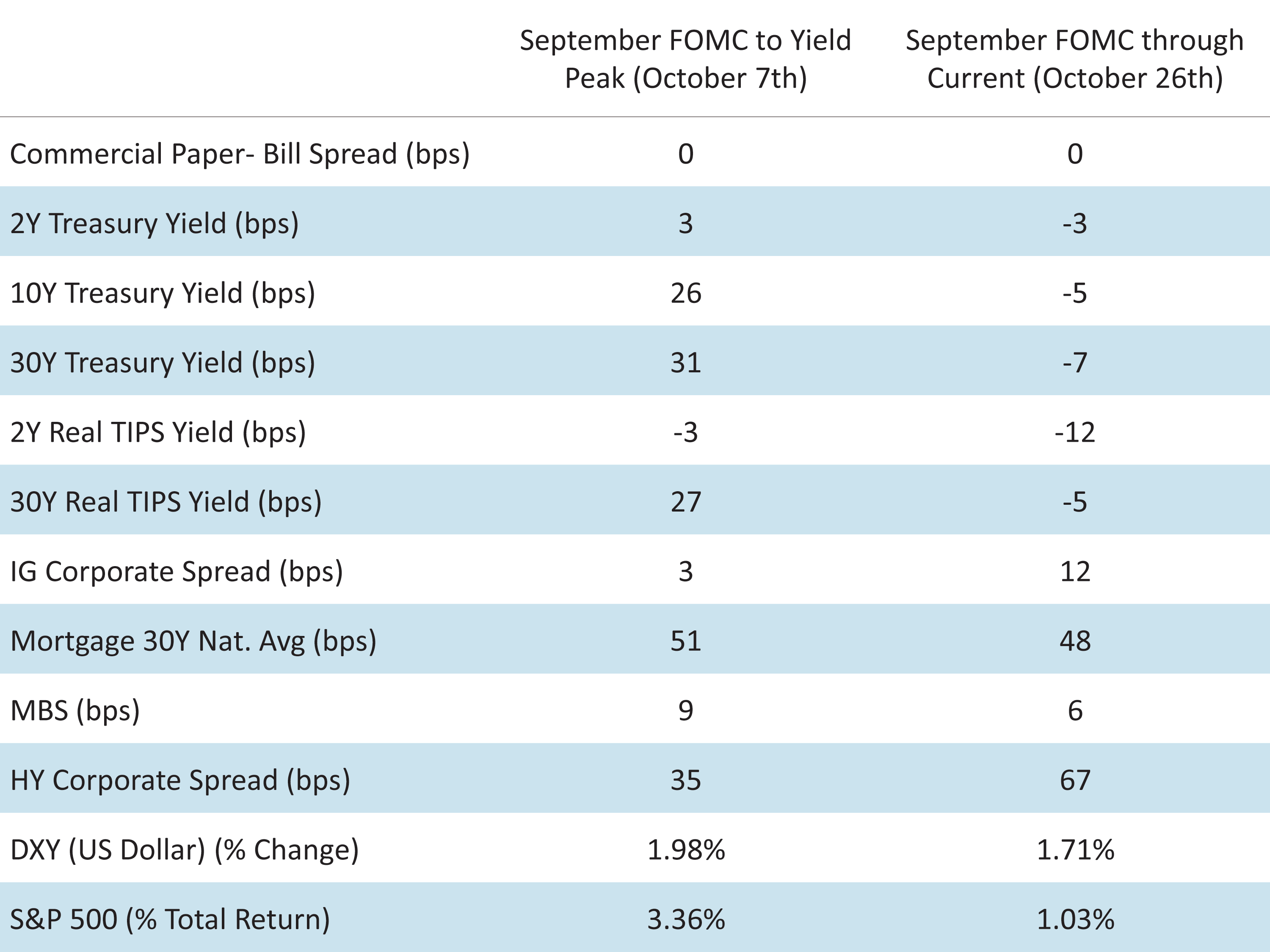
- Credit markets continue to signal pressure: Investment grade and high yield spreads have widened 12 and 67 basis points, respectively, since the September FOMC meeting.
- Borrowing costs are still restraining the economy: Mortgage rates remain nearly 50 basis points higher, giving the Fed reason to let existing tightening work before raising rates again.
This week will bring the first Federal Open Market Committee decision since the Fed’s initial rate hike in September. While markets are pricing just an 11% probability of another rate hike at this meeting, there has been no shortage of drama for policymakers to digest since the September FOMC meeting. In this edition of Notes, we examine the evolution of financial conditions across several commonly followed measures. While Treasury yields have eased materially from their early-October highs, credit spreads and mortgage rates remain notably higher, a combination that could give the Fed a reason to remain patient at this meeting.
The table below shows the change in several familiar measures of financial conditions since the September FOMC meeting, both through October 7, when Treasury yields reached a local peak, and through October 26. Following the September meeting, bond yields rose sharply, particularly at the long end, with the 10- and 30-year Treasury yields climbing roughly 25 to 30 basis points by October 7. Much of that move has since reversed, leaving nominal Treasury yields slightly below their September FOMC levels. The same cannot be said for broader financial conditions. Credit spreads continued to widen through October 26, while mortgage rates remain nearly 50 basis points higher. This divergence could be an indication that higher rates and continued credit supply are beginning to bite even as Treasury yields have retraced.
Change in Financial Conditions Indicators
Source: Sage, Federal Reserve, Bloomberg
While inflation remains higher than the Fed would like, with both CPI and PPI coming in above expectations for September, the broader picture has become more nuanced. Credit conditions have tightened, mortgage rates remain elevated, and housing activity has slowed considerably. Against that backdrop, the Fed may see little urgency to follow September’s hike with another move, instead allowing the tightening already working through financial conditions additional time to filter into the economy.