

The FOMC’s 25 basis-point rate increase today reflects a Federal Reserve that has chosen to draw the line on “delivering price stability” rather than rely on assumptions that inflation will moderate on its own. The economy continues to expand, underpinned by a resilient labor market, while elevated energy prices are threatening to broaden pricing pressure. While inflation has moved well below its peak, it remains above the Fed’s objective, and progress toward price stability has become less certain. The statement itself was shorter, and we would not be surprised to see other forward-guidance tools, such as the “dot plot” and the Summary of Economic Projections, diminish in the coming months.
FOMC Statement Strike-through Change from July
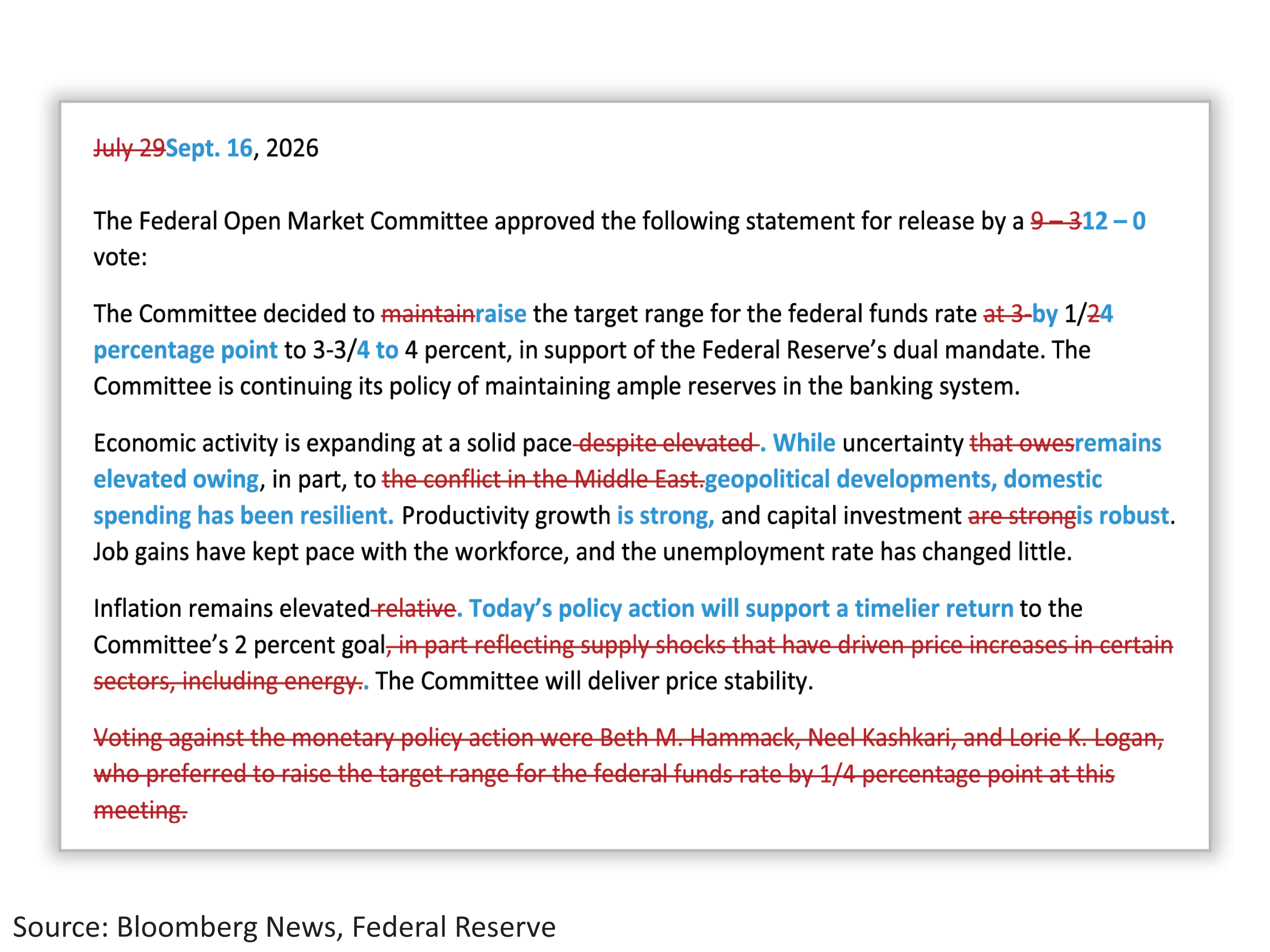
This move should be viewed as Warsh establishing credibility by putting actions behind his rhetoric of returning inflation to the Fed’s target. It is a recalibration of policy that was not restrictive enough, undoing the second half of 2025’s policy easing rather than tightening to the magnitude of a 2022/2023 cycle. On inflation, energy remains the wildcard for the path of FOMC policy. Higher oil costs and growing concerns around global energy supply create risks that inflation proves more durable and broader than anticipated. The FOMC appears unwilling to risk a renewed inflation upswing before price stability has been fully restored.
Evidence increasingly points to an economy capable of sustaining stronger growth at higher interest rates. AI-related capital spending and resilient private-sector demand have both contributed to economic performance that looks less sensitive to higher borrowing costs than in prior cycles. As a result, the shift higher in the FOMC’s long-run rate in the “dot plot” could be confirming the structural shift in the economy.
Today’s decision reinforces a higher-for-longer environment rather than a return to aggressive tightening. While inflation remains above target, the magnitude of the gap is much smaller than the post-COVID adjustment. More importantly, today’s move reflects growing recognition that the economy’s underlying speed limit may be higher than previously assumed, requiring a correspondingly higher policy rate to maintain price stability and helping establish the credibility necessary for markets to take the Fed’s commitment to its target at face value.